
Original Papal Bull — Wax Seal and Parchment (c. 1199)

Pope Boniface VIII — Author of Unam Sanctam
The Legal Foundation of Soul Ownership
Beginning in 1302 with Pope Boniface VIII's Unam Sanctam, a series of Vatican decrees legally established ownership of every human soul on Earth — and divided the physical world among the Catholic powers. These were not religious declarations. They were legal instruments. And they have never been repealed.
The Record of Decrees
These five documents form the legal backbone of global soul and land ownership. They are on file. They have never been rescinded. They remain — in the eyes of canon law — fully in effect today.
| Year | Name | Pope | What It Claimed | Impact Today |
|---|---|---|---|---|
| 1302 | Unam Sanctam | Boniface VIII | All human souls on Earth belong to the Roman Catholic Church. Every ruler must submit to the Pope. | Foundation of all international law. Claim on every soul born into any legal system derived from canon law. |
| 1455 | Romanus Pontifex | Nicholas V | Granted Portugal the right to enslave any people they "discovered" in Africa and Asia. Established the Doctrine of Discovery. | The legal basis for colonialism. Still referenced in US Supreme Court decisions to deny indigenous land rights. |
| 1481 | Aeterni Regis | Sixtus IV | Divided the world between Spain and Portugal. Confirmed the Pope's authority to give away land he did not own. | Established the precedent that the Vatican can legally divide the entire Earth among Catholic powers. |
| 1493 | Inter Caetera | Alexander VI | Gave Spain all lands west of a line in the Atlantic. Ordered that any non-Christian people found there be converted or enslaved. | The direct legal foundation for the colonization of the Americas. Still referenced in property law disputes. |
| 1537 | Sublimis Deus | Paul III | Declared indigenous peoples of the Americas to be rational human beings — and therefore souls subject to Vatican authority. Could not be enslaved — but could be "spiritually" owned. | Extended Vatican soul-ownership doctrine to the entire population of the New World. |
Deep Dive
Unam Sanctam — "One Holy" — is arguably the most consequential legal document in human history. Issued at the height of a dispute between Pope Boniface VIII and King Philip IV of France over the taxation of clergy, it was designed to assert the absolute supremacy of papal authority over all temporal (worldly) rulers.
The bull declares that there is "one Holy, Catholic and Apostolic Church" outside of which there is no salvation or remission of sins — and that this Church is subject to the Pope. It then goes further: it declares that every human being on Earth is subject to the Pope for their salvation. This is not merely a claim of spiritual guidance — it is a claim of legal jurisdiction over every soul.
The significance of this document cannot be overstated. Every legal system in the Western world descended from Roman law. Roman law became Canon law under the Church. Canon law became civil law across Europe. Civil law became the basis of commercial law, admiralty law, and corporate law. The chain is unbroken.
When you appear in a court of law, you are appearing in an ecclesiastical court. The black robes worn by judges are the robes of the Church. The bench is the altar. The "bar" (where attorneys stand) is the "bar" of the Church — the separation between the laity and the clergy. You are a layman — without legal standing — unless you have a priest (lawyer) to represent you before the Church court.
Unam Sanctam was never rescinded. Pope John Paul II's "Mea Culpa" in 2000 acknowledged the Church's historical abuses — but it was not a legal revocation of any papal bull. In canon law, a papal bull remains in effect until it is explicitly superseded by another papal bull. None of these have been superseded.
Watch & Learn
Pope Boniface VIII and Papal Authority Over the World
The Devil Worshipping Pope — Pope Boniface VIII
Pope Boniface VIII — Unam Sanctam Explained
The 1493 Papal Bull and Inter Caetera Explained
Unam Sanctam and Vatican Control of Souls
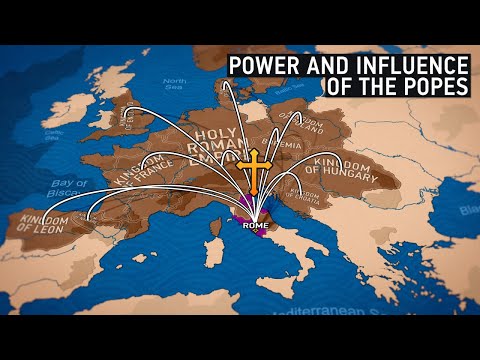
The Origins of Papacy and the Road to Power